Maxbelt Baltic
← Products

Plastic modular belts

A modular belt selected around your process.

Solutions for straight, curved, horizontal and inclined conveying — from food processing and packaging to machine building and general manufacturing.

Plastic modular conveyor belts in different constructions

Application-led selection

One product family. Many possible configurations.

Plastic modular belts are assembled from interlocking modules and driven positively by sprockets. Their construction makes it possible to combine belt width, pitch, surface, material and accessories around the actual conveying task.

Maxbelt Baltic compares suitable supply options instead of forcing every project into one brand. We help define a workable specification, identify alternatives and prepare a commercially sensible proposal.

Belt architecture

Start with the conveyor path and product.

The right construction depends on what is being conveyed, how the conveyor is arranged and what happens around the belt.

01

Straight-running belts

For horizontal, inclined and declining conveyors where the belt follows a straight path.

02

Side-flexing and radius belts

For curves and layouts that combine straight and curved conveyor sections.

03

Flat-top surfaces

A closed, stable conveying surface for controlled product handling and accumulation.

04

Open and flush-grid surfaces

For drainage, airflow, cooling, washing and reduced product contact area.

05

Friction Top surfaces

High-friction inserts help control products on inclined, declining or stop-and-go conveyors.

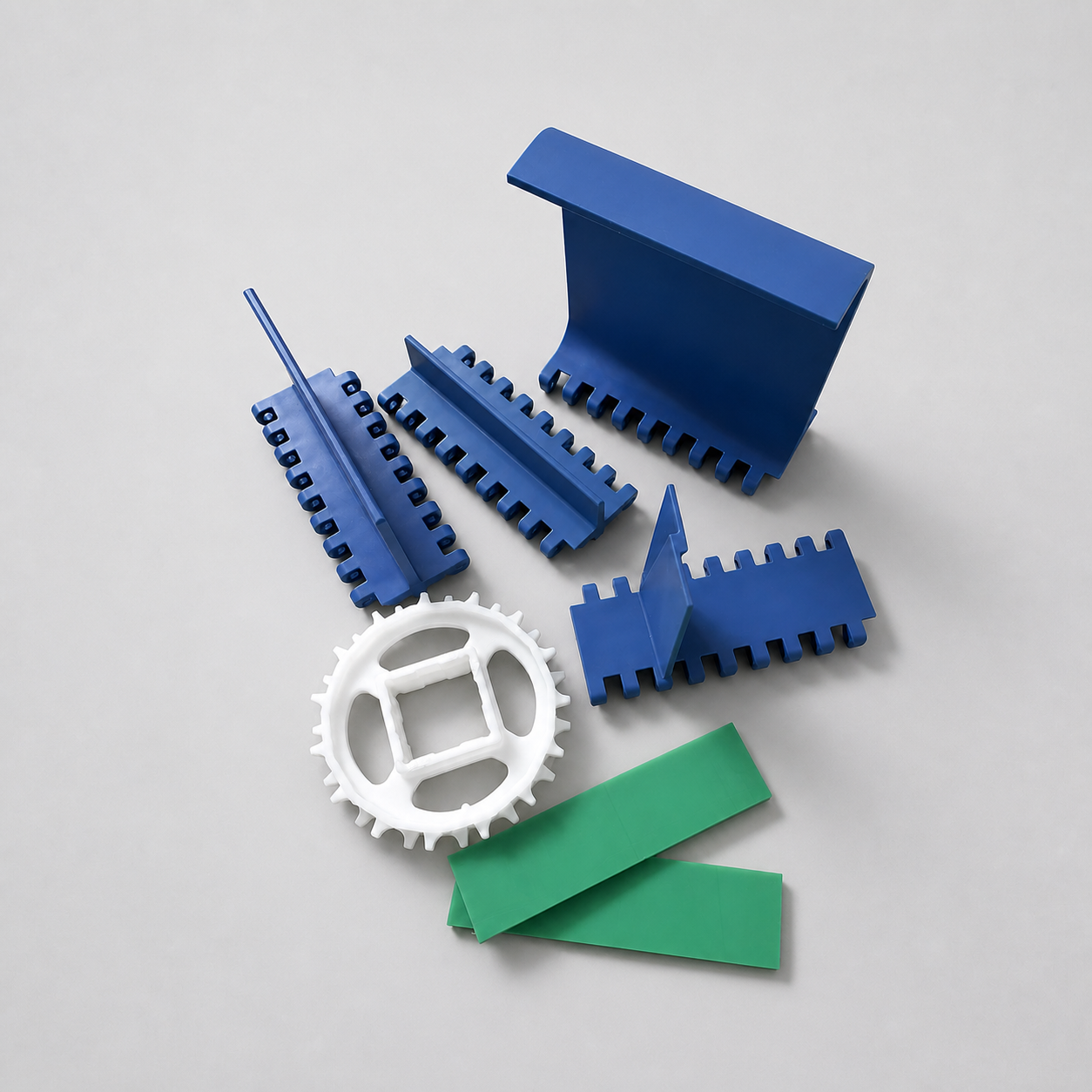
Sprocket, flights, side guards and guide components for modular belts

Build the complete belt

Surfaces, flights and components matched to the duty.

Depending on the chosen belt construction, the conveying surface can be configured with Friction Top inserts, flights or cleats, side guards or rollers. Sprockets, connecting rods, wear strips and guide profiles complete the system.

  • Friction Top surfaces for grip on inclined or declining sections
  • Flights for inclined conveying and product separation
  • Side guards for product retention
  • Sprockets matched to belt pitch and shaft
  • Wear strips and guides for support and tracking
  • Plastic or stainless-steel connecting rods, depending on the design

Material selection

The polymer matters as much as the belt design.

Final suitability must be checked against temperature, load, cleaning agents, product contact and the operating environment.

Polypropylene (PP)

A versatile option for many general conveying duties and chemically demanding environments.

Polyethylene (PE)

Often considered for wet processes and low-temperature applications.

Acetal (POM)

Selected where low friction, dimensional stability and higher mechanical load capacity matter.

Special materials

Application-specific variants for wear, impact, temperature or detection requirements may be available.

Material compliance documentation is available for selected materials. Any food-contact or other regulatory requirement should be stated at the inquiry stage and confirmed for the proposed product.

Typical applications

From exposed food to packed products and industrial components.

Food processingBeverage and packagingLogistics and warehousingMachine buildingAutomotiveGeneral manufacturing

A better inquiry gets a better answer

What should you send us?

Not every field is essential. A few clear photos and a short description are often enough to start the discussion.

Send application details ↗
  • Product and application
  • Straight, curved, horizontal or inclined belt path
  • Belt width, length and pitch — if known
  • Load, speed and operating temperature
  • Wet or dry operation, cleaning method and chemicals
  • Existing belt designation, drawing or clear photos
  • Required flights, side guards, sprockets or wear strips
  • Food-contact or other compliance requirements
  • Required delivery date

Have a conveyor challenge?

Send a photo, dimensions or the current belt designation. We will help define the next step.

Request a quote ↗